
N.E.S.H.A.M.A.H.
(NANOSTRUCTURED EDLC STORAGE HESS ADVANCED
MATERIALS AUTOMOTIVE HYBRIDS)
ABOUT US AND THE ORIGIN OF OUR PROJECT
Vision and Philosophy: The Energy Driving Matter
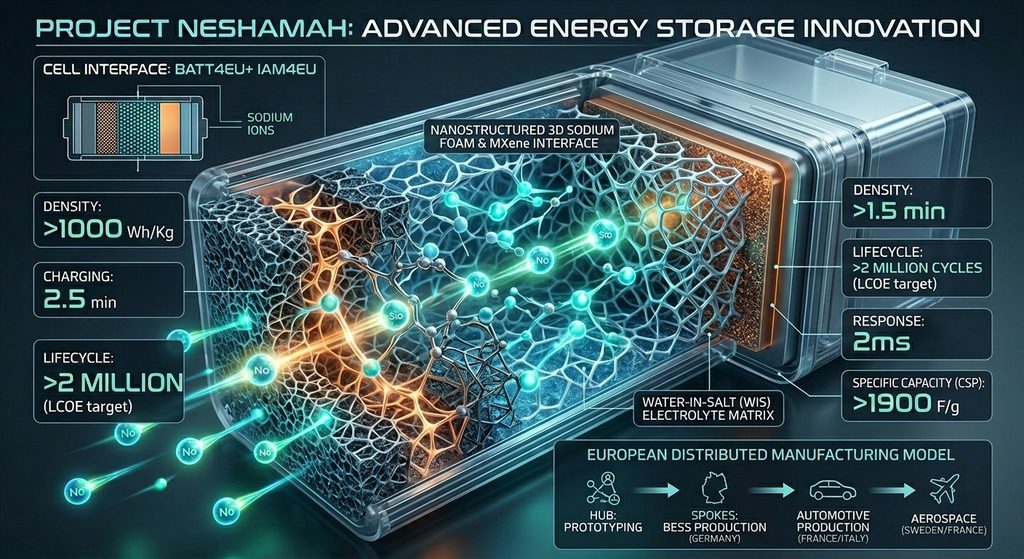
Inspired by the biblical concept of Neshamah—the pure, incorruptible vital breath that brings matter to life—the N.E.S.H.A.M.A.H. Project was created to redefine the future of energy storage in Europe. Combining the depth of theological metaphor with the utmost rigor of chemical engineering, the consortium proposes a next-generation technology based on abundant, safe, and eco-friendly elements (such as sodium and aqueous solutions), liberating the industry from its reliance on lithium and critical raw materials.
Technological Innovation (30 Proprietary Patents)
The core of the project is protected by a portfolio of 30 industrial patents developed to overcome the traditional limitations of energy density, charging speed, and cycle life:
- Aqueous Electrolytes and Safety (WIS): The use of ultra-concentrated Water-in-Salt solutions that ensure zero flammability, high stability, and environmental sustainability.
- Advanced Materials and Nanostructures: 3D sodium foam (Na foam) anodes and two-dimensional MXene coatings to prevent degradation and eliminate dendrite formation.
- Scalable Manufacturing (Sol-Gel & SSR): Energy-efficient solid-state and liquid-phase synthesis processes for cathode materials with ultra-high specific capacity.
Key Targets and High-Impact Performance KPIs
- Ultra-Fast Charging: Full charge achieved in just 2.5 minutes.
- Energy Density: Exceeding 1000 Wh/kg at the advanced system level.
- Exceptional Cycle Life: Over 2 million charge/discharge cycles, drastically reducing the Levelized Cost of Energy (LCOE).
- Instantaneous Grid Response: Just 2 milliseconds for power grid stabilization.
- Cathodic Specific Capacity (CSP): > 1900 F/g.
Hub & Spoke Distributed Industrial Model
Overcoming the risks and capital expenditure (CapEx) of centralized gigafactories, NESHAMAH adopts a flexible, federated model:
- Central Consortium (Hub): Dedicated to advanced research, chemical validation, and rapid prototyping.
- Distributed Production (Spoke): Mass production is decentralized across individual EU Member States based on the local partners’ specializations and market interests (BESS for stationary grids, hybrid Automotive, Aerospace).
Social and Geopolitical Impact for Europe
- Human Capital Preservation: A platform for the safeguarding, reskilling, and redeployment of engineers, chemists, and specialized technicians affected by recent crises in the European battery sector.
- Technological Sovereignty: Independence from foreign supply chain monopolies and external decision-making.
- Sustainability and Ecological Transition: Significant reduction of toxic solvents and fluorinated polymers.
Alignment with European Programs
NESHAMAH is designed to meet the strategic requirements of Horizon Europe initiatives:
- BATT4EU + IAM4EU (RIA): Advanced materials, electrochemistry, and next-generation concepts (TRL 3–5).
- BATT4EU + Made in Europe (IA): Advanced manufacturing, pilot lines, and industrial scale-up (TRL 5–7).
R&D Strategic Initiative | Horizon Europe Programme (BATT4EU / IAM4EU)
1. The Project
The NESHAMAH project stands at the forefront of European research into advanced energy storage systems for sustainable mobility.
Designed to overcome the structural limitations of current lithium-ion batteries regarding charging speed, lifespan, chemical safety, and raw material sustainability, NESHAMAH integrates advanced nanostructured materials, high-energy supercapacitors, and next-generation aqueous electrolytes into a ultra-high-performance hybrid architecture.
2. Innovation & Core Technologies
The technology at the heart of the NESHAMAH project rests on three scientific and industrial pillars:
- High-Energy EDLC Supercapacitors: Utilization of MXenes (2D transition metal carbides/nitrides) and functionalized graphene for electrodes, delivering high power density (kW/kg) alongside unprecedented energy density (Wh/kg).
- Safe & Eco-friendly Electrolytes: Development of superconcentrated aqueous Water-in-Salt (WiS) and gel/solid formulations. These electrolytes are inherently non-flammable, eliminating thermal runaway risks while significantly reducing costs compared to traditional organic solvents.
- Hybrid Energy Storage System (HESS: EDLC + Na-ion): Smart integration of EDLC cells (handling power peaks, rapid acceleration, and regenerative braking) with Sodium-ion (Na-ion) batteries for cruising energy. Managed by a predictive Energy Management System (EMS) algorithm, the system extends overall operating lifetime beyond 10 years or 300,000 km.
3. Objectives & Strategic Impacts
- Extreme Cyclability: Over 100,000 charge/discharge cycles for EDLC cells with minimal degradation.
- Environmental Sustainability: 30–40% reduction in carbon footprint (LCA) compared to conventional lithium batteries.
- European Strategic Autonomy: Elimination of dependency on critical and rare raw materials (such as Lithium and Cobalt) by utilizing abundant materials sourced within the European value chain (Critical Raw Materials Act).
- Automotive Validation: Complete testing and validation on a real demonstrator vehicle under real-world operating conditions.
4. European Consortium
To bridge the gap between laboratory research and industrial scale-up, NESHAMAH brings together a balanced consortium of 14 top-tier partners across 8 European countries:
- Project Coordinator: H2 ENGINEERING Srls (Italy)
- Research Centers & Universities: CEA-Liten (France), Fraunhofer ICT (Germany), VTT (Finland), Uppsala University (Sweden), KIT / Helmholtz Institut Ulm (Germany), Politecnico di Milano (Italy).
- Industrial Partners, SMEs & Automotive OEMs: Stellantis Europe, Valeo, Solvay, Skeleton Technologies, Altris AB, CIDETEC, BMZ GmbH.
5. Puglia Innovation Hub: Prototyping Laboratory
As part of the operational roadmap, H2 ENGINEERING Srls is driving the setup of an industrial prototyping and research center in Apulia (Italy), located within the Single ZES (Special Economic Zone) of Southern Italy.
Equipped with controlled environments (ISO 7 Clean Room), high-current cyclers, and pilot assembly lines, the laboratory is dedicated to electrolyte synthesis, electrode coating, and prototype manufacturing of advanced SSR V4 cells, making a concrete contribution to regional technological leadership and high-skilled employment.